
How Utilitech's Infrared Quartz Technology Actually Works: The Science Behind Instant, Even Heat
Most space heaters blow hot air around a room, but our infrared quartz models work on an entirely different principle—one borrowed from the sun itself. Instead of heating air that rises and circulates unevenly, infrared quartz heater technology emits electromagnetic waves that warm objects and people directly, much like sunlight streaming through a window on a winter day.
Understanding how this technology actually functions helps explain why quartz heaters feel different the moment you switch them on, why they never make a room stuffy, and why the warmth lingers on your skin even after you step away. We'll walk through the core components, the physics at play, and what sets modern quartz systems apart from older resistance designs.

The Core Component: Why Quartz Tubes Matter
At the heart of every infrared quartz heater sits a tungsten filament enclosed inside a sealed quartz glass tube. When current flows through the filament, it reaches temperatures near 1,500°F—hot enough to glow orange-red—and that incandescent wire radiates infrared energy outward in all directions.
Quartz glass was chosen for a specific reason: it transmits infrared wavelengths with minimal absorption, unlike ordinary soda-lime glass that blocks much of the spectrum. The tube protects the fragile filament from oxidation and physical damage while letting nearly all the radiant heat pass through unimpeded. Infrared heaters rely on this transparency to maximize efficiency, converting over 85 percent of electrical input directly into radiant warmth rather than wasting energy heating a metal enclosure first.
The quartz also withstands rapid temperature swings without cracking, which is why these heaters reach full output within seconds of being switched on and cool just as quickly when turned off—no long warm-up period, no lingering residual heat in a heavy element.
How Infrared Wavelengths Transfer Heat Without Moving Air
Infrared radiation sits just below visible red light on the electromagnetic spectrum, with wavelengths between 0.75 and 1,000 microns. The type of infrared a heater emits depends on the filament temperature: short-wave (near-infrared) comes from very hot elements above 2,000°F and penetrates deeper, while medium-wave (mid-infrared) from tungsten filaments around 1,500°F strikes a balance between penetration and surface warmth.
When those waves strike your skin, clothing, or furniture, the molecules absorb the energy and begin vibrating faster—heat at the molecular level. No air movement is required because the energy travels as electromagnetic waves, the same way sunlight crosses 93 million miles of vacuum to warm Earth’s surface. This direct transfer explains why you feel warmth immediately when standing in front of an infrared heater, even if the room’s air temperature hasn’t changed yet.
Convection heaters, by contrast, must first warm air molecules, then rely on buoyancy to circulate that heated air throughout the room—a slower, less targeted process that leaves cold pockets near floors and windows.
Reflector Design and Directed Heat Distribution
Infrared energy radiates in all directions from the glowing filament, so every quartz heater uses a parabolic or semi-cylindrical reflector positioned behind the tubes to redirect that energy forward. The reflector is typically polished aluminum or steel coated with a high-reflectivity finish, chosen because it bounces infrared wavelengths efficiently without absorbing much heat itself.
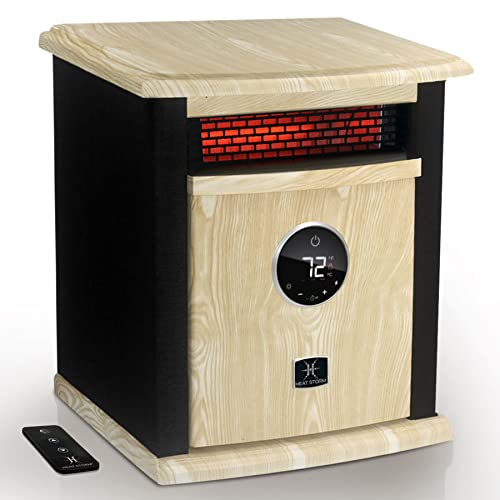
Our infrared quartz tower heater employs a vertical array of quartz tubes paired with a tall reflector to spread warmth evenly from floor to ceiling, eliminating the cold ankles common with low-mounted units. The cabinet heater variant uses a wider reflector and oscillating base to sweep the beam across a room, covering more square footage without requiring multiple units.
Beam Pattern and Coverage Distance
The shape of the reflector determines whether heat concentrates in a tight cone or fans out across a broad area. A deep parabolic curve focuses energy into a narrow, intense beam useful for spot heating a desk or workbench, while a shallow curve spreads warmth over a wider zone at slightly lower intensity. Most residential models compromise with a medium-depth reflector that delivers comfortable warmth up to 10 feet away without creating a harsh hot spot directly in front of the unit.
Why Quartz Heaters Don't Dry Out Indoor Air
One of the most common observations from first-time infrared users is that the air never feels parched, even after hours of continuous heating. This isn’t coincidence—it’s a direct consequence of how the technology operates.
Convection and forced-air heaters pull cool air across a hot element, raising its temperature by 40–60°F in a fraction of a second, then push that superheated air into the room. Rapid heating lowers the air’s relative humidity because warm air can hold more moisture than cold air, and if you haven’t added any water vapor, the percentage drops. Over time, indoor humidity can fall to 20 percent or lower, leading to dry skin, static shocks, and irritated sinuses.
Infrared quartz heaters bypass this mechanism entirely. They don’t heat the air in the room at all—they heat the objects and people. The air temperature does eventually rise as warmed surfaces re-radiate some energy, but this happens gradually and never involves blasting air across a 1,500°F element. The result is a room that feels warm without the parched, stuffy sensation that forced-air systems create.

Energy Efficiency and the Physics of Radiant Heating
Infrared quartz heater technology achieves higher effective efficiency than convection models not because it uses less electricity per watt—both types convert nearly 100 percent of input power to heat—but because radiant energy delivers warmth where you actually need it, when you need it, without waiting for air to circulate.
A 1,500-watt convection heater in a 200-square-foot room must raise the entire air volume to a comfortable temperature before you feel relief, and every time a door opens or a draft enters, that heated air escapes and the cycle starts over. A 1,500-watt quartz heater warms you directly within seconds, and because most of the energy never gets stored in the air, opening a door has minimal impact on your comfort—the warmth is on your skin and in the objects around you, not floating toward the ceiling.
This targeted delivery also means you can run a quartz heater at a lower thermostat setting and still feel comfortable, reducing total runtime and lowering energy costs over a heating season. Independent testing shows radiant heaters can cut whole-room heating bills by 20–30 percent compared to forced-air alternatives when used for zone heating in occupied spaces.
Understanding the Real Advantages of Quartz Infrared Heat
Infrared quartz heater technology isn’t just a different way to generate warmth—it’s a fundamentally different approach to comfort, one that mimics the sun’s own method of heating Earth without relying on air as a middleman. The quartz tubes, tungsten filaments, and reflector assembly work together to deliver instant, directed heat that feels natural, doesn’t dry the air, and wastes less energy warming spaces you’re not occupying.
Once you understand the physics—electromagnetic radiation, wavelength penetration, and direct molecular excitation—the performance differences stop feeling like marketing claims and start making intuitive sense. Whether you’re comparing heating methods or troubleshooting why a particular room never seems to warm up with a traditional heater, the science behind infrared explains what you’re experiencing.
Common Questions About Infrared Quartz Heating
No. The quartz tubes emit only infrared wavelengths in the heat spectrum, well below the frequency of ultraviolet light. The tungsten filament never gets hot enough to generate UV, and quartz glass blocks any trace UV that might form. There are no combustion byproducts because the system is fully electric with no flame or fuel.
Infrared energy travels at the speed of light and begins warming your skin the moment it strikes you, just like stepping into sunlight. Convection heaters must first heat air molecules, then wait for that air to rise, circulate, and reach you—a process that takes several minutes depending on room size and airflow patterns.
Yes, as long as the unit is rated for damp locations and positioned away from direct water contact. The sealed quartz tubes resist moisture far better than open-coil resistance heaters, and because infrared doesn't rely on air circulation, humidity doesn't interfere with heat delivery. Always check the product's IP rating and installation guidelines before use in wet areas.
Most quartz tube assemblies are rated for 5,000 to 10,000 hours of operation, equivalent to several years of daily use in a residential setting. The tubes themselves rarely fail—it's usually the tungsten filament inside that eventually burns out, much like an incandescent light bulb. Many models offer user-replaceable tube cartridges for easy maintenance.
The glow is simply incandescent light from the hot filament and poses no safety risk beyond indicating the unit is on and the tubes are hot to the touch. Most modern units include protective grilles spaced to prevent accidental contact, and tip-over switches cut power immediately if the heater falls. The glow actually serves as a helpful visual reminder that the unit is active.
Better than convection heaters in those conditions. Because radiant heat warms objects and people directly rather than relying on air stratification, a 12-foot ceiling doesn't trap your warmth overhead. Poor insulation still allows heat to escape through walls, but you'll feel comfortable sooner because the infrared energy reaches you immediately instead of after the entire air volume has been heated.